
Art Update
January 2026

As promised, here is an update on my recent art activities:
On Saturday and Sunday, February 21-22, from 10 to 1, I’m scheduled to lead a workshop on watercolor monotypes at the Jamestown Arts Center. Check out the listing for the workshop, and sign up if you’re able to come! It’s going to be SO fun. Readers of this newsletter may recall a previous post that featured a couple of my watercolor monotypes.
I had a piece in the JAC’s Members Show, which came down on January 10, 2026.
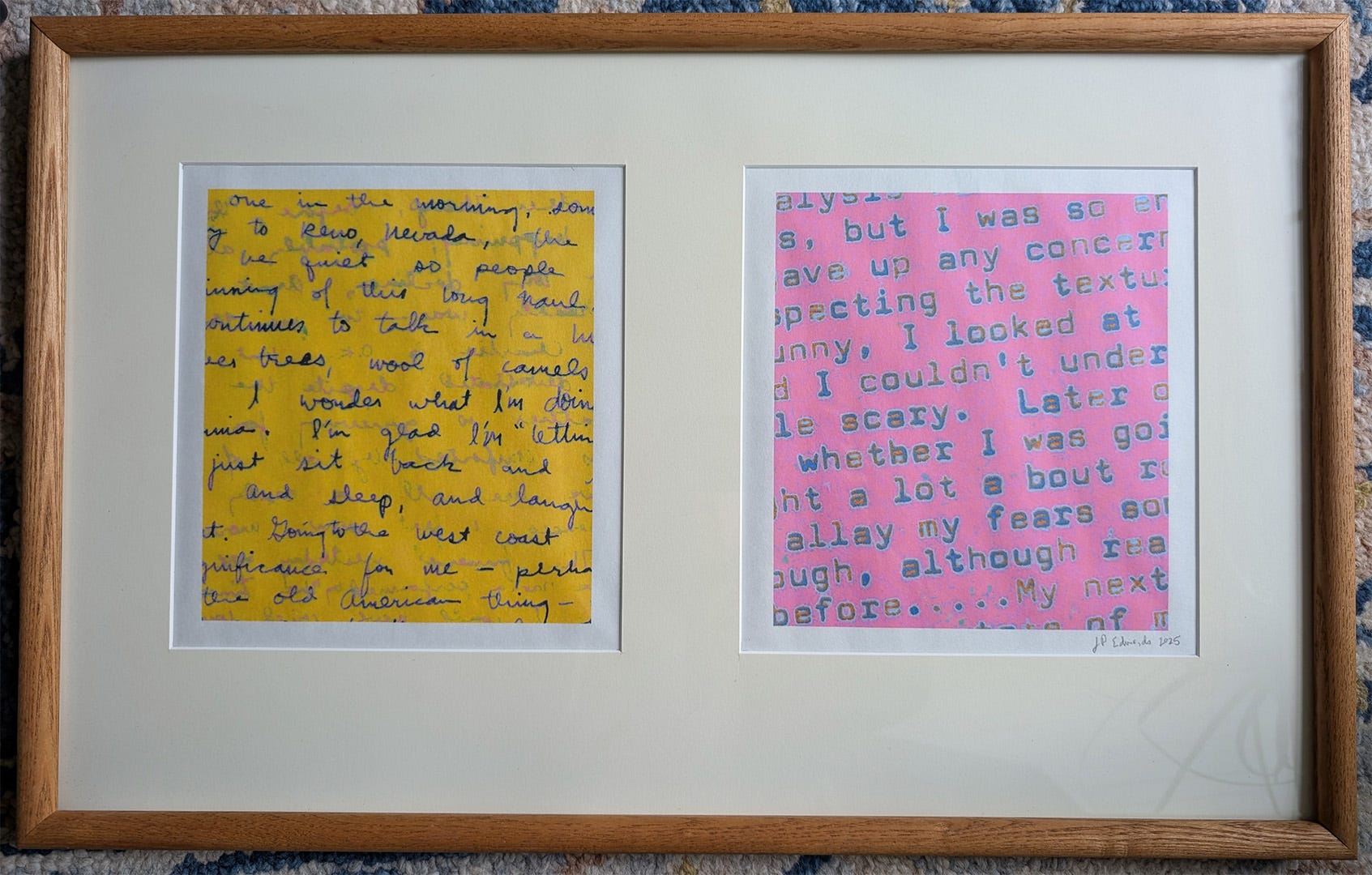
It’s an exploration of fragments of text that I wrote decades ago. On the left (yellow background), a fragment of a draft of a letter to a friend describing a bus trip across Colorado, Utah, Nevada, and California. On the right (pink background), a fragment of a letter written to another friend on my Hermes 3000 describing another journey. Wish I had held on to that typewriter!
In the home studio, I’ve just completed a couple of small projects.
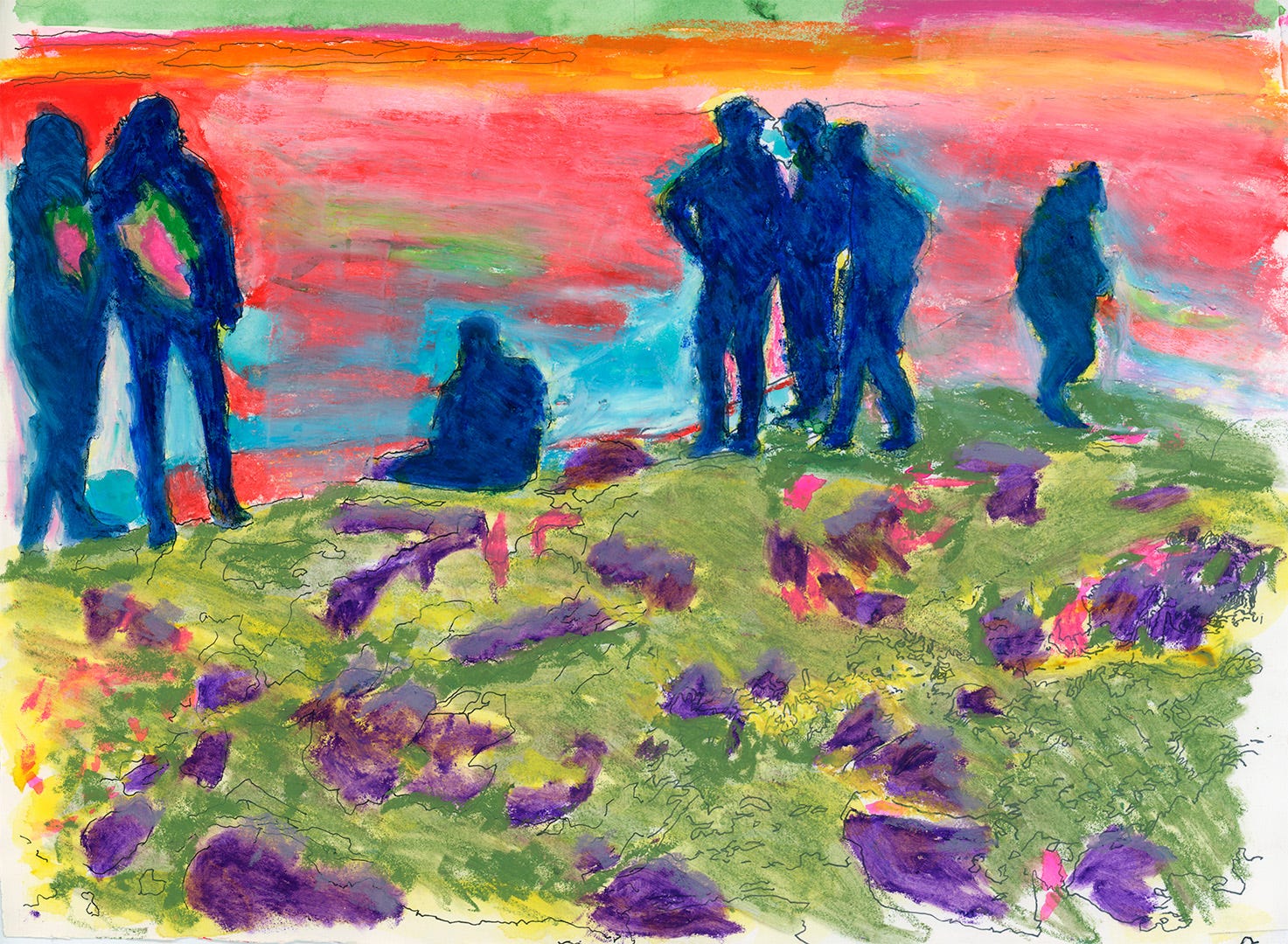
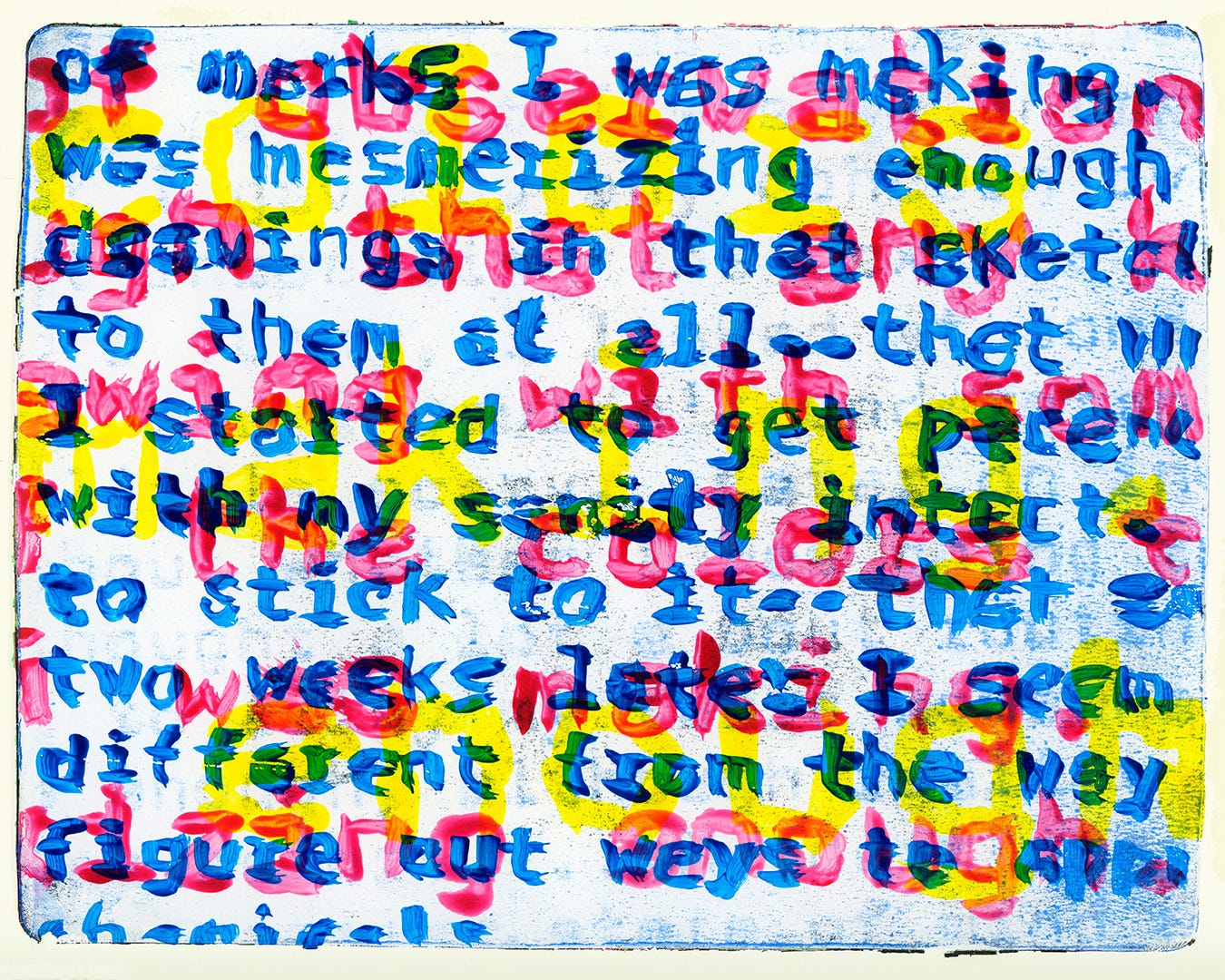
Above, one of my experiments with gel plate acrylic transfers. The words are jumbled fragments painted from one of my typescript carbons from decades ago.
Except for the recent wonderful shows at the Jamestown Arts Center, and an open house at Jeff Soderbergh’s gallery in Portsmouth featuring work by friend and teacher Lisa Barsumian, I haven’t seen a lot of art since a visit to Wellfleet in September when I got to see Mark Brennan’s installation, Full Fathom Five, on Wellfleet Conservation Trust’s Herring Overlook Trail. I’m looking forward to seeing Sara Nalle’s Goya-inspired etchings with aquatint at the Spring Bull Studio & Gallery in Newport. And I am told that the Ruth Asawa retrospective at NYC’s Museum of Modern Art is not to be missed.
I finally developed and scanned an expired roll of Kodak Tri-X, shot with a Canon Demi half-frame camera. Despite not knowing whether the light meter was functioning, I got a surprising number of usable negatives. A half-frame camera lets you get 72 images on a “36-exposure” roll of 35mm film. The image size is 18x24mm as opposed to the usual 36x24mm, so the grain of Tri-X shows up even more:

I also finished another roll of 35mm film, this one in a plastic Diana+ camera with 35mm back. This time I used the color negative film Lomochrome Metropolis, which is known for its unsaturated colors. The Diana+ 35mm back, with the supplied mask, can shoot edge-to-edge including the area where the sprocket holes are. When you do this, all bets are off on composing your shot through the viewfinder, since the camera is designed to be used with larger-format (6x6cm) 120 film.
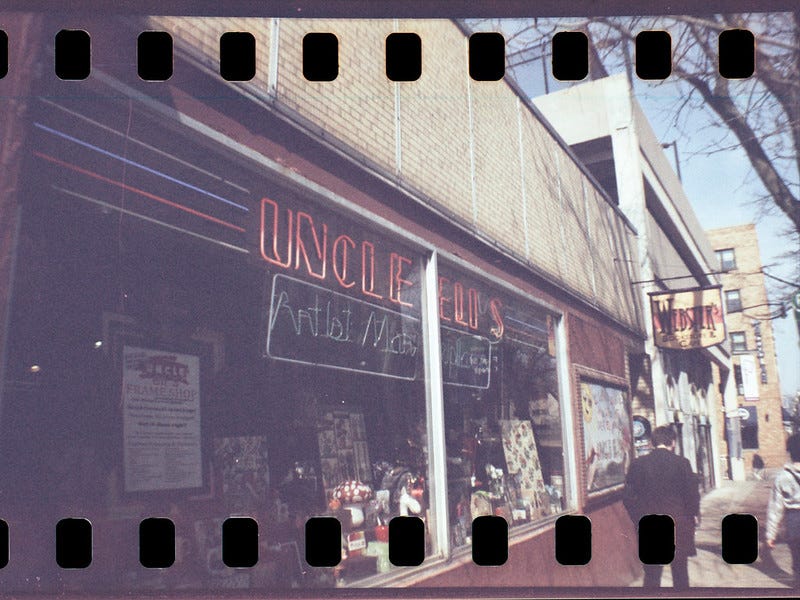
Vintage camera buffs to the contrary not withstanding, it is quite possible to simulate the pleasing aesthetic of film with a modern digital camera. I’m told that Fujifilm cameras excel at this, but I gather that it is also possible with post processing in Adobe Lightroom and/or Photoshop, with the appropriate plug-ins. Can someone point me in the right direction?
Next time, the music update.